
A look at the M-021001 cell therapy technology in Bo'ao Lecheng
When going up and down stairs, it feels like a needle is stuck in the knee joint; when squatting down, you cannot stand up; when the weather turns cold, the knee joint is the first to “forecast” it — meniscus injury is one of the most common keywords in orthopedic clinics. In the traditional approach, patients are usually faced with only two options: put up with it or have it removed. In Bo'ao Lecheng, Hainan, a third option is being implemented.
I. First, what is the meniscus?
The meniscus consists of two crescent-shaped fibrocartilage pads in the knee joint, one on each side (medial and lateral), wedged between the femur and the tibia. Its functions are varied and critical: cushioning pressure, stabilizing the joint, transmitting load, and reducing friction — it is essentially the knee joint's “natural shock absorber.”
The trouble is that about the inner two-thirds of the meniscus have almost no blood supply, making it difficult for nutrients to reach it. Once torn, its self-repair capacity is poor.
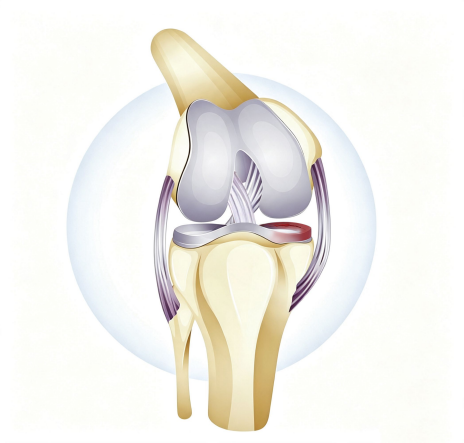
▲ The meniscus lies between the femur and the tibia (schematic diagram)
Who is most susceptible to injury?
▸ Athletes: sudden stops, sharp turns, and twisting during soccer, running, and jumping can directly cause tears through shear force;
▸ Manual laborers and people who squat or kneel for long periods: long-term compression and wear lead to degenerative tears;
▸ People with obesity: joint instability and malalignment concentrate stress on localized areas of the meniscus and cause uneven wear.
Four signals from the body: pain during activity (especially twisting, squatting, and going up and down stairs), clicking during flexion and extension, sudden joint locking, and limited range of motion and weakness when walking. If these occur, early knee MRI is recommended for a definitive diagnosis.
II. The three traditional treatment paths, each with its own obstacles
There are currently three main options, and their common problem is that most provide only “symptomatic treatment” and can hardly make the damaged meniscus regrow tissue.
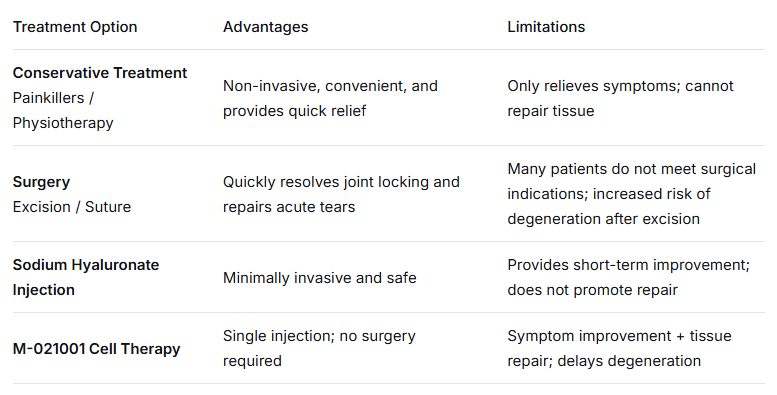
III. M-021001: a third path from “pain relief” to “repair”
M-021001 is a pluripotent stem cell-derived functional cell therapy product developed by Beijing Zehui Chenxing Biotechnology Co., Ltd. in collaboration with the Institute of Zoology, Chinese Academy of Sciences, and the Beijing Institute for Stem Cell and Regenerative Medicine. It is specifically developed to reduce knee meniscus injury. The route of administration is intra-articular injection into the knee — no surgery, and only a single injection is needed.
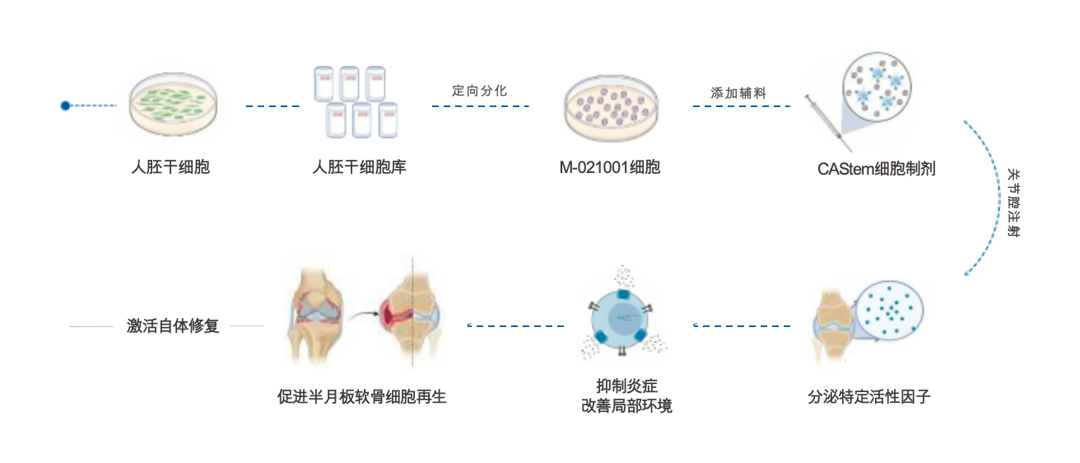
▲ Technical pathway from the National Stem Cell Resource Center to intra-articular injection (source: project training materials)
① Strong anti-inflammatory and swelling-reducing effects: secretes anti-inflammatory factors, improves the intra-articular environment, and rapidly relieves inflammatory pain and swelling;
② Activation of autologous repair: secretes chemokines, mobilizing the body's own cells to migrate to and accumulate at the injury site;
③ Promotion of tissue regeneration: through directed differentiation and paracrine effects, promotes regeneration of meniscal chondrocytes and delays joint degeneration.
IV. How solid is this “endorsement”?
▸ Clinical trial approval from the National Medical Products Administration: M-021001 is the first hESC-derived cell product in China approved for registered clinical trials targeting meniscus injury (acceptance number CXSL2000067);
▸ Phase I clinical trial published: no serious adverse events occurred during the 12-month follow-up of 18 subjects; MRI and knee function scores showed positive signals; the results were published in the international journal Signal Transduction and Targeted Therapy;
▸ Authoritative source and controllable quality: seed cells come from the National Stem Cell Resource Center (China's first clinical-grade human embryonic stem cell line); the same cell source ensures consistent biological characteristics between batches; the entire process follows CGMP standards and has passed quality testing by the National Institutes for Food and Drug Control;
▸ Approved for implementation in Lecheng: on June 17, 2026, the first nationwide clinical application of M-021001 cell injection was completed at Bo'ao Super Hospital, and the project was incorporated into Lecheng's real-world research system;
▸ Policy basis: approved for translational application under Lecheng's “National Nine Measures” pilot policy and the Regulations on Promoting the Application of New Biomedical Technologies in the Bo'ao Lecheng International Medical Tourism Pilot Zone of the Hainan Free Trade Port.
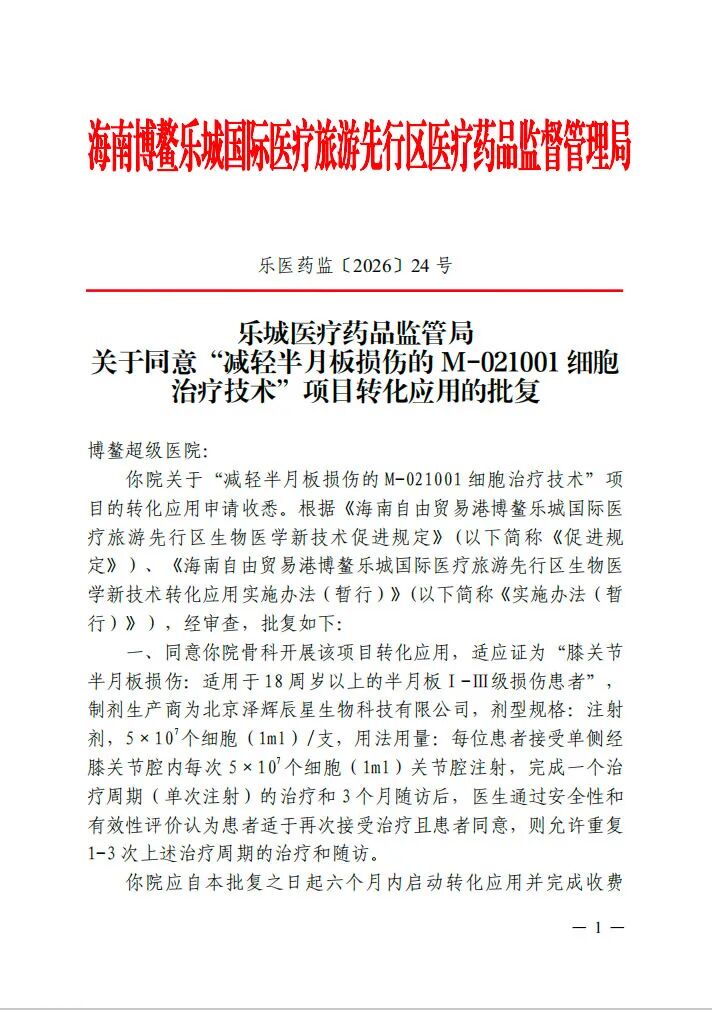
▲ Project translational application approval from the Lecheng Medical Products Administration (excerpt)
V. Clinical follow-up: one year later, lesion volume decreased substantially
The following cases are compiled from hospital training materials and all involve patients with Grade III injuries. Note: these are individual cases and do not mean everyone can achieve the same results.
Case 1 | 52-year-old woman, right knee traumatic Grade III injury
She had not received special treatment before and had knee clicking with persistent pain. One month after treatment, she had no difficulty going up and down stairs; one year later, imaging assessment showed a 58% reduction in lesion volume, and she could perform daily activities freely.
Case 2 | 42-year-old man, left knee degenerative Grade III injury
He had difficulty flexing the knee and squatting. Three months after treatment, he could perform normal activities without pain; one year later, lesion volume had decreased by 53%, and he could perform heavy physical activity without restriction.
Case 3 | 33-year-old woman, left knee traumatic Grade III injury
Oral painkillers were ineffective. One month after treatment, she had no pain during joint movement; one year later, lesion volume had decreased by 50%.
Case 4 | 29-year-old man, left knee sports-related Grade III injury
He had limping, clicking, and difficulty squatting. One month after treatment, the middle segment of the medial meniscus returned to normal; three months later, pain, clicking, and catching disappeared; one year later, the posterior horn of the lateral meniscus recovered to Grade I.
VI. Who can use it and who cannot
✓ Eligible patients (requires physician assessment)
· 18–65 years old
· MRI-confirmed Grade I–III meniscus injury
· Daily or near-daily knee pain lasting more than 1 month
· Symptoms persist after more than 3 months of conservative treatment, with no current surgical indication
✕ Contraindications
· Infection at the injection site or in the knee joint
· Severe allergy history / allergy to formulation components
· Lower limb joint deformity or ligament tear that makes the procedure unsuitable
· Coagulation dysfunction or inability to stop anticoagulant drugs
· History of malignant tumor
· Injection of other cell products within 3 months before treatment
VII. Process, cost, and hospital
Six-step treatment process: information filing → preliminary assessment (knee MRI and other imaging) → review of assessment results → appointment for orthopedic consultation → after consultation approval, medical records are created, informed consent is obtained, and additional required tests are completed → injection in the operating room → in-hospital observation for 1–2 hours → visits at 7, 30, and 90 days.
Price: publicly disclosed after filing with the hospital — RMB 80,000 per vial (50 million cells per vial), intra-articular injection; after physician assessment, 1–3 treatment cycles may be repeated. Currently not covered by medical insurance; patients must pay out of pocket.
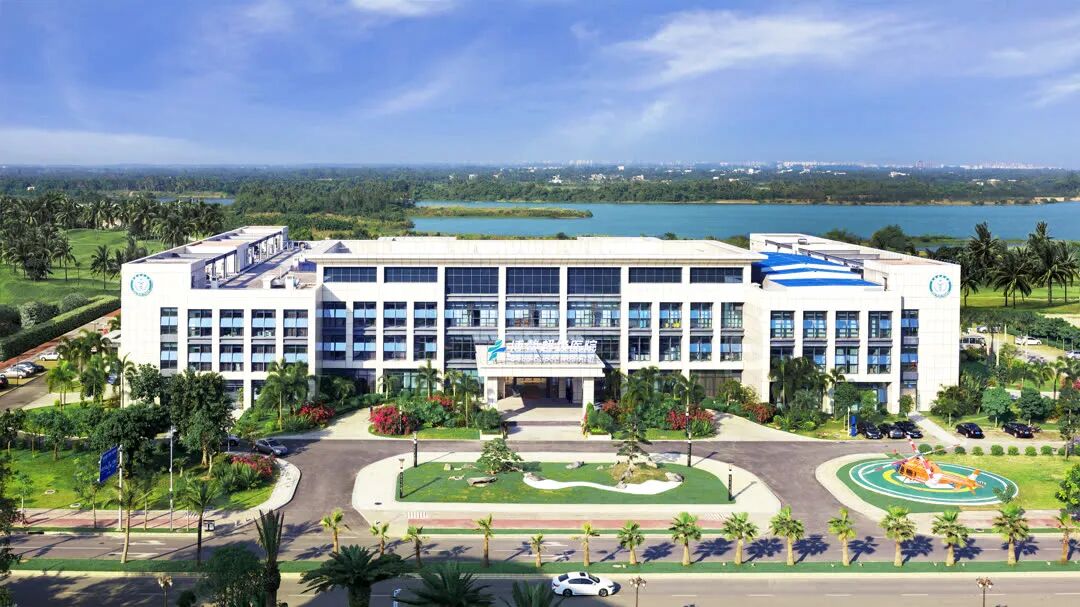
▲ Bo'ao Super Hospital (Hainan Bo'ao Lecheng International Medical Tourism Pilot Zone)
Finally, a few plain truths
① The exact meaning of “approved” is: within the Lecheng Pilot Zone, at designated hospitals and at the filed price, translational application is carried out for patients who meet the indications — it does not mean the drug has been marketed nationwide, nor does it mean “the state guarantees efficacy”;
② Stem cell therapy is not a matter of “one injection and the tissue grows back.” What has been published is Phase I safety and efficacy signals; individual differences objectively exist;
③ Please make appointments through official hospital channels. Stay away from anyone who charges “agency fees” or “channel fees,” or promises a “guaranteed cure or full refund”;
④ If joint locking, obvious deformity, or rapid swelling and inability to bear weight after injury occurs, go first to the orthopedics / sports medicine department of a regular hospital; do not miss the surgical window while waiting for an injection.
- Next
- None


