
At 1 a.m., Lao Zhou stood in front of the mirror again.
The light was on, and the increasingly noticeable bald patch on the top of his head was particularly glaring under the incandescent bulb.
He instinctively pulled his hat tighter.
His wife whispered from behind:
"Actually... you weren't like this before." Those words pierced his heart like needles.
For those experiencing hair loss, it's not just hair they've lost.
Lao Zhou, 35, is a business development manager at a company.
He used to be full of vigor. Now, he dreads two things most: elevator security cameras and rainy days.
Because when the camera looks down from above, his hair parting resembles a chasm. When rain wets his hair, his entire scalp is exposed. He's tried many methods.
Minoxidil: He persisted for six months, with little effect.
Finasteride: He worried about side effects, so he took it intermittently.
Hair Transplant: After a consultation, the doctor's words left him speechless: "Your hair follicle resources at the back of your head are insufficient."
The meaning is simple:
Others can "rob Peter to pay Paul," but he's almost out of even his "walls" (hair follicles).
Until he encountered "artificial hair transplantation"
When he first heard the name, Mr. Zhou was resistant.
"Is it fake?"
"Won't it look strange?"
"Is it like those cheap wigs from before?"
But after truly understanding it, he was stunned.
This isn't "wearing a wig" in the traditional sense.
It's a technology that has been used in Europe for many years—
The fourth-generation artificial hair transplantation technology.
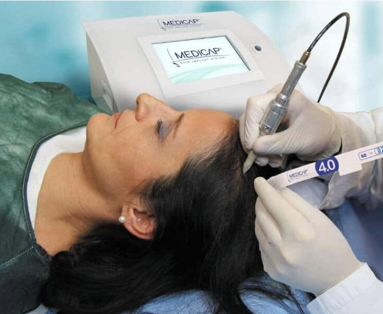
In short:
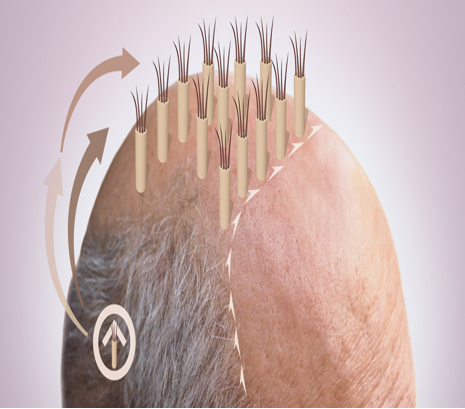
It involves directly implanting highly biocompatible artificial hair into the dermis layer of the scalp using a patented micro-anchoring structure.
*No need to wait for the hair follicles to take root
*No need to harvest hair follicles from the back of your head
*No need for surgery to cut the scalp
The change in hair density can be seen immediately after the procedure.
The most shocking thing was that I looked ten years younger immediately after the procedure.
On the day of the surgery, Mr. Zhou was very nervous.
But after it actually began, he discovered:
* Local anesthesia was used.
* Minimally invasive implantation.
* No large incisions.
* No long recovery period like traditional hair transplants.
A few hours later, the doctor handed him a mirror.
At that moment, he suddenly fell silent.
His previously graying scalp had regained its density.
His hairline was back.
His entire spirit seemed to have been suddenly "pulled back."
He said:
"For many years, I dared not look directly into a mirror."
Why are more and more people starting to pay attention to it?
Because it solves the biggest pain point of traditional hair loss treatments:
1. Slow results.
Medications often take more than six months, while artificial hair implantation—the effect is immediate.
2. Many people are simply not suitable candidates for hair transplantation.
Especially those with moderate to severe hair loss, scarring alopecia, insufficient donor area, or diffuse female pattern baldness. Traditional hair transplantation is often ineffective for these individuals.
However, artificial hair implantation does not rely on the patient's own hair follicles.
3. Increasingly natural appearance.
Fourth-generation technology can now achieve:
Multiple color matching
Different lengths
Different curl levels
High-density, natural integration
It's difficult for others to tell that a procedure has been performed.
4. Reversible and adjustable. Individual hair can be adjusted if unsatisfied. Post-operative maintenance and touch-ups are also possible.
This aspect gives many people great peace of mind.
More importantly: It's not a "three-no" technology (no production date, no manufacturer, no quality certification).
Many people don't know:
This technology is already used in many countries, including Italy, Spain, France, and Japan.
And it has CE certification.
Compared to early artificial hair technology twenty years ago,
the current fourth-generation materials have been upgraded to:
medical-grade polyamide
biocompatible polyester coating
significantly reducing the risk of foreign body reactions.
This is also a key reason for its renewed acceptance in the international market.
Not everyone is suitable for hair transplantation.
But many people finally have another option.
For those suffering from hair loss:
The most painful thing is never hair loss itself.
It's caring deeply but slowly pretending not to care.
And now, perhaps technology truly offers them a chance to start over.


