
Almost everyone who's been with a cancer patient battling cancer has experienced this kind of despair: when chemotherapy or targeted drugs are first used, the tumor is clearly shrinking and indicators are improving, but within a few months, the doctor announces, "The cancer cells have become resistant to the drugs, and the drugs are no longer effective."
When they hear the word "resistant," many people panic—are these cancer cells turning into "super cancer kings," fearless and invincible?
You're only half right: Drug-resistant cancer cells are indeed masters of adapting to their environment, but they're by no means invincible. Furthermore, they haven't evolved to be stronger, just differently.
01 First, a correction: It's "evolution," not "evolution."
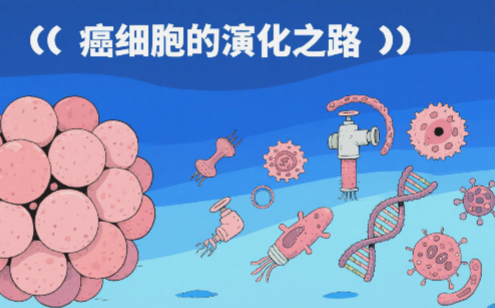
We often talk about Darwin's "theory of evolution," but the more scientific term is "evolution theory"—just like Yan Fu's translation of "On Evolution and Ethics," the core of which is "survival of the fittest," not "survival of the strong."
Humans are able to survive on Earth not because they are "more advanced" than mice and rabbits, but because their abilities to make tools and communicate in language are perfectly suited to the current environment. In a completely different scenario, humanity's advantages vanish instantly: without tools, we can't outrun wild beasts; without thermal insulation, we can't withstand extreme cold. The coronavirus of recent years further demonstrated that even simple viruses, predating humans by hundreds of millions of years, can still disrupt human society.Cancer cell drug resistance is essentially a process of "in-vivo evolution." Tumors harbor a variety of genetically diverse cancer cells, and using drugs creates a harsh environment for them: sensitive cancer cells are killed, while a few "specialized" cancer cells are able to withstand the drugs (for example, by pumping them out of the body). These surviving cells become "drug-resistant"—but this isn't "more powerful," it's simply "adapting to the drug-rich environment."
02 Drug-Resistant Cancer, Like Surviving Native Americans
When Columbus discovered the New World in 1492, it brought devastating disaster to the Native Americans: measles and smallpox brought by Europeans killed nearly 90% of them. Yet, a small number of people survived, both in Europe and America.
These survivors weren't "superior," they simply happened to be resistant to these pathogens—just like drug-resistant cancer cells, which have simply adapted to a "drug-rich environment" and aren't truly invincible. Even if they survive, they're still vulnerable to volcanoes, extreme cold, and weapons of war. The same is true for drug-resistant cancer: just because they can withstand one drug doesn't mean they can withstand all.
From a biological perspective, no cancer cell is invulnerable; it's just that we haven't yet fully discovered their weaknesses.
03 Some drug-resistant cancers cannot survive without anticancer drugs

Can you believe it? Sometimes, stopping medication can actually cure drug-resistant cancer.
Science magazine once discovered that some chemotherapy-resistant cancers survive the drug by "lying flat"—actively shutting down growth signals and inhibiting DNA repair, making them invulnerable to chemotherapy drugs (which target rapidly dividing cells). However, once the drug is stopped, these "lying flat" cancers panic: they grow slower than ordinary cancers and accumulate harmful mutations, quickly becoming outclassed.
Even more remarkable are targeted drugs. Nature magazine once revealed "anticancer drug addiction": for example, melanoma cells with BRAF mutations, once drug-resistant, become "dependent" on targeted drugs—they stop growing and even die without them.
For this reason, doctors have begun experimenting with "intermittent dosing": using the drug to kill sensitive cancers, stopping it to treat resistant cancers, and reducing side effects. But a word of caution: this approach lacks large-scale clinical data, so it requires physician evaluation; don't change the drug on your own.
04 Prepare Multiple "Weapons," New Therapies Are Here
Ultimately, there are no "invincible cancer cells," only "cancer cells adapted to their current environment." When resistance to one treatment persists, switching to another, based on a different principle, often yields results—this is the logic behind combination and sequential therapies. Chemotherapy, targeted therapies, and immunotherapy aren't a "choose one or the other" approach, but rather a "more, the better" approach.
Now, there's finally new hope in the fight against cancer—a novel anti-tumor immunotherapy (TTV) jointly developed by Academician Wang Zhenyi and Professor Xu Kecheng.
This therapy doesn't rely on a single attack method, but instead activates the body's own immune system to precisely target the tumor's weak spots. Not only does it effectively fight tumors, it can also help patients prolong their lives, bringing a real lifesaver to patients and their families struggling with drug resistance.
Fighting cancer is never a one-time decisive battle. As long as you identify the cancer cells' weak spots and have sufficient weapons, there's always a chance to control them.


